

|
Voice of the Citadel
Getting your Trinity Audio player ready...
|
In Brief
- AI exposes leadership, it doesn’t replace it – Intelligent systems reveal misaligned behaviors, unclear authority, and control-based cultures that can’t scale.
- Technical readiness is irrelevant without behavioral readiness – Organizations fail not because the tools are flawed, but because the leadership system isn’t designed for machine-speed clarity and execution.
- Leadership debt is the real obstacle – Until decision rights, trust, and accountability are restructured, AI will amplify dysfunction, not accelerate performance.
Executive Summary
Many executives believe Artificial Intelligence (AI) is the missing puzzle piece for organizational effectiveness. However, contrary to common belief, AI is not inherently transformative; it is primarily accelerative. Instead of fixing broken processes and leadership gaps, AI quickly exposes and amplifies them. If leaders misunderstand this fact, they risk costly, visible failures. At Gryphon Citadel, we have repeatedly seen AI initiatives stall, not because of technical issues, but because the leadership behaviors needed for machine-speed decision-making are absent.
This article examines the main challenge in AI adoption: unprepared leadership. It introduces Gryphon Citadel’s exclusive Leadership Readiness Framework™, specifically designed to evaluate and enhance behavioral readiness before investments go off course. With this framework, a clear path to successful AI integration is established.
The Illusion of AI Readiness
Organizations often equate technical skill with operational readiness. They perform thorough data audits, infrastructure upgrades, and vendor evaluations. However, they rarely scrutinize leadership behaviors to the same degree. When AI is introduced into an enterprise that relies on centralized decision-making, limited transparency, and risk-averse controls, the results are often disappointing.
AI implementations often retain superficial changes that mask deeper problems. Leaders heavily invest in digital tools, expecting cultural change to happen naturally. However, when leadership itself remains unchanged, AI doesn’t deliver clarity or empowerment; it underwhelms. The system may be technically sound, but without behavioral alignment, its insights go unused, its potential unrealized, and its promise unfulfilled.
What AI Does
Artificial Intelligence does not make decisions for the organization. It doesn’t choose, direct, or discipline. Instead, it relentlessly and without interpretation accelerates the behaviors already present in the system. It shows how decisions are made, who truly holds power, and where friction exists. AI is not a decision-making engine. It is a behavioral mirror that operates at computational speed.
When leadership behaviors align, authority is clear, trust is established, and transparency feels genuine, AI can then accelerate processes, enhance understanding, and broaden its reach. However, in the absence of these conditions, AI can worsen problems. Delays in decision-making become evident through real-time KPIs. Political workarounds show up as broken workflows. When trust is lacking, even if it is once hidden in informal relationships, it can turn into widespread resistance to machine-driven insights. This highlights the urgent need to align leadership behaviors for the successful adoption of AI.
AI doesn’t create new problems. It simply removes the delay that previously protected leaders from the consequences of their operating models.
AI doesn’t create new problems. It simply removes the delay that previously protected leaders from the consequences of their operating models. This highlights the urgency of addressing these issues, as AI brings them to the forefront, demanding immediate attention and resolution.
This is the most misunderstood fact in enterprise transformation: AI does not create clarity. It needs it. Without alignment, speed turns into chaos. Without transparency, automation causes alienation. Without behavioral readiness, every insight quickly becomes a point of contention – a loud, fast, and unproductive public.
Organizations don’t fail at AI. They fail because of the behaviors AI reveals.
The Real Pain – Failure Archetypes of Premature AI Adoption
Gryphon Citadel’s work in AI-rich environments has identified four recurring breakdowns, each rooted not in the code or the platform but in unresolved behavioral structures of leadership. These are not system flaws. They are organizational responses to misalignment between how decisions are made and how the enterprise is expected to function at the machine speed.
Understanding these breakdowns is essential not only to regain trust and clarity in execution but also to prevent intelligent systems from causing confusion, disengagement, and strategic issues drift.
Decision Whiplash
When AI-generated insights are inconsistently acted upon, or worse, openly overridden without explanation, the result is a loss of confidence. Teams hold back. Implementation slows down. What was meant to bring clarity instead causes doubt and hesitation. The core issue is unclear decision rights. Authority remains too concentrated, conditional, or simply ambiguous. In this environment, AI becomes just another factor in a fragile decision-making framework, leading to paralysis where there should be progress acceleration.
Shadow Systems
Despite the official deployment of AI tools and platforms, real work often continues in other places – spreadsheets, side channels, and manual exceptions. These hidden systems exist not because employees resist technology, but because people no longer believe the system accurately reflects how work is done. This gap occurs when the formal structure of work diverges from lived behavior, leading to friction, inefficiency, and quiet resistance that make AI irrelevant. The more the organization pretends that everything is aligned, the more it deepens these entrenched issues of dysfunction.
Cultural Resistance
In organizations where fear outweighs clarity, employees disengage from AI initiatives or comply without conviction. Insights are received but not used. Judgment is suppressed. Innovation stalls. This isn’t a communication issue; it’s a trust issue. People fear being made obsolete, exposed, or left behind. Without psychological safety and a clear explanation of the human role in an AI-powered system, even the best technology can’t produce the judgment and context it needs to work effectively. What appears to be low adoption is a leadership failure of courage.
Tech Mistrust
When frontline teams ignore AI recommendations and revert to legacy habits, it’s tempting to see it as resistance to change. But in most cases, it’s inconsistent leadership that undermines trust. If senior leaders don’t trust the insights themselves, override the system, interpret them selectively, or act outside its guidance, why would anyone else behave differently? Trust in technology starts with modeled behavior. When that behavior is inconsistent, credibility suffers, and the organization quietly stops using the system, even if the interface remains in place.
These are not isolated dysfunctions. They are the enterprise equivalents of immune responses, symptoms of a leadership system reacting to a perceived threat. But what AI threatens is not people. It’s ambiguous. It’s an inconsistency. It’s the illusion of clarity in systems that were never truly clearly aligned.
Left unaddressed, these breakdowns spread, draining morale, derailing momentum, and turning transformation into a credibility crisis. What starts as hesitation quickly becomes a pattern of institutional self-sabotage. And no amount of technical fixes can reverse it, because the problem was never technical to begin with.
The Real Debt – Leadership, Not Just Technology
These visible breakdowns, conflicted decisions, hidden workarounds, disengaged teams, and tech mistrust are often misdiagnosed as execution issues or user resistance. But they’re not system failures. They’re symptoms of something more profound.
The real burden in most AI journeys isn’t technical debt. It’s
leadership debt - the accumulated misalignment between how decisions are made, how trust is distributed, and how authority is exercised.
The real burden in most AI journeys isn’t technical debt. It’s leadership debt – the accumulated misalignment between how decisions are made, how trust is distributed, and how authority is exercised.
Technical debt can be mapped and managed. Leadership debt compounds silently until AI makes it visible.
The irony is stark. AI was meant to unlock scale and speed. But when layered onto cultures that haven’t modernized, how they lead, it becomes a high-speed feedback loop, revealing every leadership inconsistency at scale.
Digital Performance Theatre and AI as False Flag
Some organizations appear to be thriving in their AI transformations. Dashboards pulse with real-time data. Metrics are visualized across business units. Automated insights reach frontline teams on cue. But when performance stalls, decisions revert to instinct, or teams quietly disengage, the façade begins to fracture. What’s revealed isn’t a transformation. It’s a production.
At Gryphon Citadel, we refer to this phenomenon as Digital Performance Theatre, the outward display of AI-enabled sophistication without the corresponding behavioral substance. The systems are online, but the organization hasn’t changed how it decides, governs, or executes. The tools look modern. The behavior remains unchanged.
This breakdown happens when leadership optics exceed operational follow-through. Metrics are reviewed but not acted upon. Insights are circulated, but frontline teams lack the authority to act. Dashboards are populated, but they serve as signals of competence rather than instruments of control. The enterprise is instrumented, but not intelligent.
This form of transformation theatre is particularly insidious because it convinces leadership that progress has been made. The architecture of performance is in place, but the underlying culture remains unchanged. The trust gaps, ambiguous accountabilities, and unexamined leadership reflexes that previously slowed down the organization are still active, only now they’re producing friction at scale, behind a digital veneer.
Digital Performance Theatre doesn’t collapse suddenly. It decays gradually. Confidence erodes. Execution drifts. Talent disengages. And the system quietly reverts to manual decision-making beneath the surface, while the leadership team continues to focus on dashboards.
The result? A high-cost illusion of intelligence, without any strategic benefit.
If AI insights are not consistently acted upon, if dashboards don’t shift behavior, and if autonomy remains theoretical, the organization is not operating at machine speed. It’s simulating progress. And simulation, over time, becomes stagnation dressed in code.
AI as a False Flag of Modernization
Digital Performance Theatre is only one layer of the problem. At a deeper level sits a more strategic, and more dangerous, misjudgment – the belief that adopting AI is itself proof of transformation.
Too often, AI is used not as a capability but as a credential. The platform is deployed. The press release goes out. Dashboards go live. A Center of Excellence is launched. From the outside, the organization appears to have undergone significant evolution. But beneath the surface, the leadership model remains fundamentally unchanged.
This is what we call AI as a False Flag of Modernization, when the presence of intelligent systems is mistaken for proof that the organization has become smart in its behavior.
Leaders continue to make instinct-based decisions while promoting data-driven rhetoric. Authority remains centralized, even as systems are designed for distributed action. Teams are told they are empowered, but quickly learn that real decisions are still made behind closed doors.
In these environments, AI becomes a symbol of innovation without the substance of transformation. The organization signals progress but doesn’t embody it. And the longer this dissonance persists, the more corrosive it becomes, especially for top talent, who quickly spot the gap between message and reality.
AI is not a proxy for maturity. It is a test of it. And when leadership systems haven’t evolved to match the intelligence of the tools they deploy, the outcome isn’t transformation, it’s disillusionment.
At Gryphon Citadel, we look for the early signs. Systems that function technically but not behaviorally, strategies that depend on AI without reexamining governance, and leadership teams that speak the language of agility but operate in deference to hierarchy. In these cases, AI is not failing. It’s faithfully reflecting the legacy culture that put it in place.
The cost isn’t just failed adoption. It’s credibility. Because once AI is used as proof of modernization, every inconsistency it exposes becomes a strategic liability. Evidence that the transformation was skin-deep.
Modernization doesn’t happen when AI is deployed. It begins when leadership behaviors change.
From Readiness to Reinvention
Recognition is not readiness.
The failure patterns described, decision whiplash, shadow systems, cultural resistance, digital theatre, and symbolic AI adoption, aren’t isolated incidents. They are symptoms of a deeper problem: leadership systems designed for control and consistency are now trying to operate in an environment that demands speed, adaptability, and trust in distributed decision-making.
This is the pivot point.
AI readiness isn’t about capability maturity models, technical certifications, or change communications. It’s about whether the behaviors that govern leadership are compatible with how intelligent systems operate. And most are not.
Legacy leadership was designed for latency, hierarchy, and control through delays. Machine-speed leadership requires something completely different: clarity without hierarchy, decision-making without bottlenecks, and alignment without delays or micromanagement.
Organizations that continue to frame AI as merely a digital initiative miss the point.
AI is a leadership challenge. It’s not just about testing systems—it tests behaviors. And it does so with ruthless precision.
Is your leadership system ready to absorb what AI will reveal?
To succeed, enterprises must undergo behavioral reinvention at the leadership level. They need to shift from merely stating values to codifying behaviors. The transition from centralized control toward operational trust. Move from symbolic dashboards to teams capable of making decisions. This is not just change management; it is a transformation of the leadership system.
This is where Gryphon Citadel begins, where others stop. Before the platform is deployed, before the data flows, before the model runs, we ask: Is your leadership system ready to absorb what AI will reveal?
If not, the solution isn’t more training. It’s reinvention.
The Gryphon Citadel Leadership Readiness Framework™
Recognizing these challenges, Gryphon Citadel has developed a comprehensive framework that evaluates and addresses leadership readiness before deploying AI. Our Leadership Readiness Framework™ identifies the key behavioral factors that organizations must change to achieve AI success. It includes four essential components:
Factor 01 - Decision Locus
Decision locus refers to the clarity and appropriateness of decision-making authority. In many legacy systems, decision-making authority is concentrated at the top, resulting in bottlenecks when swift, data-driven action is required. Successful AI integration depends on clear and distributed decision rights that empower the right actors at the appropriate levels.
- Diagnostic: Can teams clearly articulate who owns decisions, and why?
- Gryphon Citadel Approach: Establish explicit decision rights frameworks to distribute authority transparently, empowering informed action at speed.
Factor 02 - Friction Transparency
Friction transparency involves making internal conflicts and decision tensions visible and actively managing them. Legacy organizations hide friction to maintain a facade of harmony, which creates unseen resistance. AI requires organizations to recognize tensions, enabling quick and constructive resolution openly.
- Diagnostic: Does your organization actively acknowledge and resolve internal tensions, or conceal them?
- Gryphon Citadel Approach: Implement friction visibility protocols that normalize tension as constructive and necessary, rather than punitive, enabling swift resolution.
Factor 03 - Systemic Integrity
Systemic integrity involves aligning announced processes with proper practices. Misalignment creates shadow systems, damages trust, and reduces agility. For AI to succeed, declared protocols and real behaviors must be fully aligned.
- Diagnostic: Do organizational practices consistently reflect formally documented processes?
- Gryphon Citadel Approach: Conduct integrity audits to reveal gaps, realign processes, and reinforce behavioral accountability through targeted interventions.
Factor 04 - Execution Elasticity
Execution elasticity gauges how adaptable organizations are under pressure. AI’s rapid insights inevitably disrupt routines, challenging current methods. Rigid organizations tend to collapse under the stress of AI, while elastic organizations utilize these disruptions to their advantage and evolve.
- Diagnostic: How does your leadership respond when faced with disruptive insights, by resisting change or adapting?
- Gryphon Citadel Approach: Build resilience through scenario simulations, establishing leadership behaviors that adapt dynamically under pressure.
The Leadership Maturity Curve – Mapping the Journey
Successful AI transformation isn’t simply about adopting new technologies. It’s about shedding outdated leadership reflexes. Organizations that operate effectively at machine speed do so because their leadership approaches evolve in lockstep with their systems. Gryphon Citadel’s Leadership Maturity Curve™ brings that transformation into sharp focus, making it visible, measurable, and actionable.
The model identifies five critical behavioral dimensions, Mindset, Control, Information, Culture, and Accountability, where legacy postures must shift for AI to function as an accelerant rather than a drag on execution. Each dimension represents a potential fault line. Left unaddressed, these fractures widen under the pressure of real-time decision-making, distributed authority, and algorithmic insight.
The complete maturity curve is presented below. On the left: the control-based tendencies of hierarchical organizations. On the right: the behavioral upgrades necessary to lead at machine speed.
Gryphon Citadel Leadership Maturity Curve™
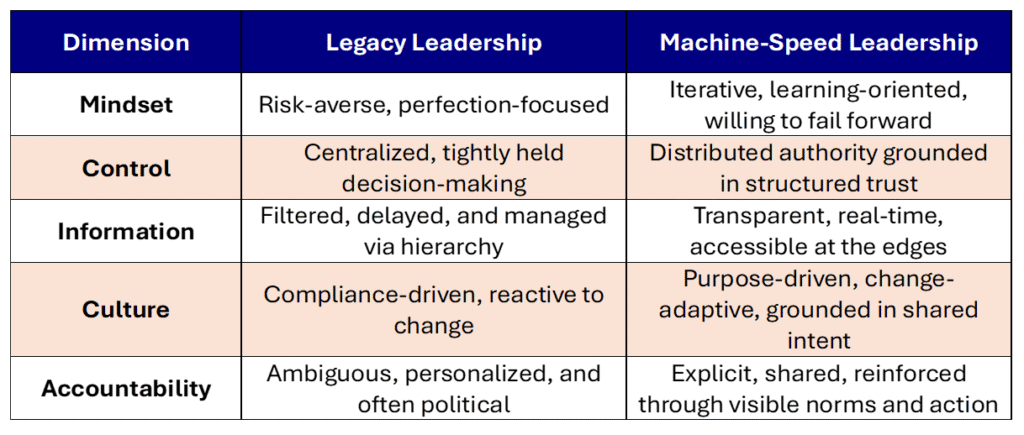
Mindset – From Risk Avoidance to Iterative Learning
Mindset needs to shift from avoiding risk to iterative learning. In traditional settings, safety is achieved through delays—more data, approvals, and a focus on perfection. However, machine-speed organizations see failure as feedback and focus on learning while moving forward. They make informed decisions without waiting for complete certainty.
Control – From Centralization to Distributed Authority
The control must shift from concentration to distributed authority. AI decentralizes insight, requiring action to occur close to the edge. If decision rights remain siloed at the top, the system cannot respond effectively. Trust must be structurally embedded, not earned on a case-by-case basis.
Information – From Filtered Summaries to Radical Transparency
Information must shift from filtered summaries to complete transparency. Hierarchical organizations often sanitize inputs. But intelligent systems—and the people using them—need raw, real-time data to respond effectively. Machine-speed leadership requires the courage to face what’s real, not what’s comfortable.
Culture – From Compliance to Purpose and Performance
Culture must shift from compliance to purpose and performance. Rules-based environments slow down progress. Machine-speed cultures gain coherence from shared intent. They reward initiative and embrace the creative tension that comes with empowered, insight-driven decision-making teams.
Accountability – From Ambiguity to Explicit Ownership
Accountability needs to move from ambiguity to clear ownership. When outcomes are obscured by committees or hidden behind political uncertainty, intelligent systems come to a halt. Fast-paced leadership cultures define ownership, record their reasoning, and create real-time feedback loops that promote clarity and understanding momentum.
Understanding where your leadership system stands is just the start. What truly matters is the willingness to act quickly, visibly, and without excuses. The cost of doing nothing is no longer measured in months or quarters; it’s measured in milliseconds, trust erosion, and lost relevance.
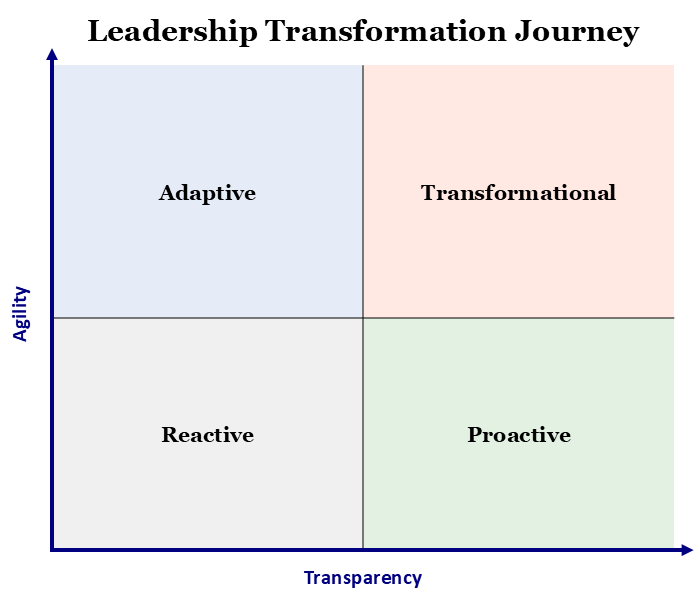
Without leadership transformation, leaders become the bottleneck. And in an AI-driven enterprise, bottlenecks operate at machine speed, slowing everything from insight to action, from innovation to implementation execution.
Where are you on the Leadership Transformation Journey? AI
is not here to rescue leaders. It is here to reveal them.
Using the Curve to Map and Close the Readiness Gap
Gryphon Citadel uses this maturity model not only as a diagnostic tool but also as a means for transformation. In our leadership development engagements, we help executive teams follow a structured process of behavioral realignment, identifying their current position on the curve and defining the necessary shifts to advance in a positive direction.
In many cases, organizations straddle columns, demonstrating machine-speed information flows while maintaining centralized control. This is where most AI failures originate: partial maturity, where technology advances faster than the behaviors needed to interpret, validate, and act on it.
By mapping against the curve, leadership teams can reveal the invisible. They can uncover contradictions between declared intent and actual behavior, and address them before AI amplifies the issues of dissonance.
From Readiness to Reinvention
AI deployment should follow, not precede, leadership transformation. Organizations that successfully adopt AI proactively invest in developing leadership behaviors. They assign decision rights, normalize transparency, embrace constructive friction, align stated practices with actual behaviors, and foster agile responsiveness to change disruption.
They view AI as a means to accelerate existing leadership practices, and they develop leadership systems specifically designed to operate at machine speed.
Deploy a Mirror Before a Machine
Gryphon Citadel’s experience consistently demonstrates the core truth that AI doesn’t fix leadership; it reveals it. Organizations committed to succeeding with AI must prioritize leadership transformation as the foundation, not the afterthought.
Before deploying AI tools, organizations need to hold up a mirror: honestly examining decision-making clarity, friction transparency, systemic integrity, and execution flexibility. Only then can AI investments deliver real operational growth, strategic insight, and lasting performance improvements.
AI doesn’t fix leadership. It reveals it.
AI’s future is already here. The organizations that thrive will be those whose leadership behaviors align with their speed, clarity, and adaptability complexity.
About Gryphon Citadel
Gryphon Citadel is a management consulting firm headquartered in Philadelphia, PA, with a European office in Zurich, Switzerland. Known for our strategic insight, our team delivers invaluable advice to clients across various industries. Our mission is to empower businesses to adapt and flourish by infusing innovation into every aspect of their operations, leading to tangible, measurable results. Our comprehensive service portfolio includes strategic planning and execution, digital and organizational transformations, performance enhancement, supply chain and manufacturing optimization, workforce development, operational planning and control, and advanced information technology solutions.
At Gryphon Citadel, we understand that every client has unique needs. We tailor our approach and services to help them unlock their full potential and achieve their business objectives in the rapidly evolving market. We are committed to making a positive impact not only on our clients but also on our people and the broader community. At Gryphon Citadel, we transcend mere adaptation; we empower our clients to architect their future. Success isn’t about keeping pace; it’s about reshaping the game itself. The question isn’t whether you’ll be part of what’s next—it’s whether you’ll define it.
Our team collaborates closely with clients to develop and execute strategies that yield tangible results, helping them to thrive amid complex business challenges. Let’s set the new standard together. If you’re looking for a consulting partner to guide you through your business hurdles and drive success, Gryphon Citadel is here to support you.
Explore what we can achieve together at www.gryphoncitadel.com
