

Become a Client

Let’s discuss your next big idea.

We can't wait to hear from you.  Please tell us a little about you by completing the form and we will get back to you as soon as possible.

Looking for a new career opportunity?

    Gryphon Citadel needs your contact information so we can contact you about our services. You may unsubscribe from these communications at any time. For information on how to unsubscribe, as well as our privacy practices and commitment to protecting your privacy, please review our

    Privacy Policy.

    Voice of the Citadel
    Getting your Trinity Audio player ready...

    In Brief

    • In modern enterprises, reputation is a highly volatile and fast-moving asset that accounts for up to 63% of a company’s market value, a figure that is often misunderstood.
    • Branding and reputation must be separated: one is projection, the other is perception. This distinction is not just a matter of semantics, but a fundamental concept in corporate management. Only behavioral coherence builds trust, making it crucial to distinguish between the two.
    • The 5+2 Pillar Digital Reputation Framework and the DRRQ score offer leaders a blueprint to quantify, govern, and strengthen trust.

    Reputation at Machine Speed

    Corporate reputation in the digital age is a high-wire act without a net. A single misstep, a CEO’s errant tweet, a product flaw that goes viral, an employee’s exposé on Glassdoor, or a disappointed client can unravel decades of goodwill in hours. The digital echo chamber amplifies every whisper into a roar, with no mute button, no rewind, and no mercy. The consequences are dire.  A 2021 study by the World Economic Forum and Deloitte estimates that reputation accounts for up to 63% of a company’s market value, a figure expected to increase as connectivity deepens (also, Weber Shandwick and KRC Research, 2020). In this unforgiving arena, reputation isn’t a soft asset: it’s the hard currency of trust, driving loyalty, investment, and resilience. The potential loss is not just financial, but also in terms of customer loyalty and investor trust.

    Too often, leaders blur the distinction between reputation and branding, overemphasizing image while underinvesting in behavior. Branding is the promise a company crafts, its logo, vibe, and voice. Reputation is the judgment stakeholders render on whether that promise holds, shaped not by marketing but by behavior across customers, employees, investors, regulators, and algorithms. In a world where perceptions shift at digital speed, managing reputation demands a strategic overhaul. This is not just a suggestion, but a necessity in the digital age. Drawing from decades of advising global firms, this article unpacks the divide, introduces a 5-Pillar Digital Reputation Framework, and equips leaders to turn risk into advantage. The prize? Elevating reputation to a core strategic function, and securing a competitive edge where trust is the ultimate currency.

    What Corporate Reputation Means

    Corporate reputation is the collective verdict of stakeholders – customers, employees, regulators, investors, suppliers, and the public – on a firm’s trustworthiness, competence, ethics, and intent. Actions over time forge it, experienced through every interaction, from product quality to leadership conduct. Unlike financial metrics, reputation is intangible, yet its impact is seismic. The World Economic Forum and Deloitte’s 2021 study ties it to 63% of market value, while RepTrak’s 2020 data shows a 1-point trust index rise boosts revenue 2.5%, a $250 million lift for a $10 billion firm.

    In the digital era, this asset is both turbocharged and treacherous. Stakeholders wield unprecedented power to observe, judge, and amplify views, untethered from corporate control. Strong reputations provide an edge: top talent flocks to high-rated firms (a 1-star Glassdoor drop cuts hiring power by 10%, according to the Harvard Business Review in 2022); customers stay loyal (67% of purchase decisions hinge on trust, according to Nielsen in 2021); and investors reward resilience. Bain’s 2021 research adds that resilient firms recover from crises 50% faster. Reputation isn’t a nice-to-have; it’s a performance driver, volatile as never before.

    The Fault Line – Branding vs. Reputation

    Branding and reputation answer distinct questions. Branding asks: What do we want people to believe? Reputation asks: What do people think, based on experiences? Branding is a curated projection: marketing-led, visually driven, campaign-focused. It’s Nike’s “Just Do It,” Apple’s sleek minimalism, or Tesla’s innovation halo – aspiration in high definition. Reputation is an unscripted reality, co-created by behaviors, interactions, media narratives, and signals like ESG scores or lawsuits.

    This matrix lays bare the divide:

    The fault line can fracture a firm. Volkswagen’s “Das Auto” promised engineering excellence. Still, the 2015 emissions scandal, involving cheating on tests to fake green credentials, caused $30 billion in costs and led to a 20% loss of the German car manufacturer’s customer baseWells Fargo’s branding thrived, yet fake accounts tanked its reputation, triggering a $1.7 billion fine in 2022. Patagonia aligns with sustainability isn’t just a tagline, but a 1% sales donation, earning a 91% trust score. Branding attracts; reputation secures. Coherence poses a challenge. Credibility trumps cosmetics.

    The Digital Amplifier – Risks and Realities

    Digital platforms have rewritten the physics of reputation. News hits at warp speed. United Airlines’ 2017 passenger-dragging video garnered 87 million views in just a few days, resulting in a 4% decline in its stock price. Algorithms favor emotion. Outrage outpaces nuance. Tencent’s WeChat faced a 2022 privacy backlash in China, with user posts cutting growth by 5% in a quarter. Stakeholders broadcast rants via Glassdoor, TikTok exposés, or X threads, and digital scars stick. Nestlé’s water extraction controversies in Europe persist online, impacting its ESG rating by 12%.

    Beyond viral feedback, digital risks include cyberattacks and unauthorized data access, which erode brand value and trust. A 2023 IBM study estimates the average cost of a data breach at $4.45 million, with reputational damage amplifying financial losses. Crises originate in the real world, such as product failures and ethical lapses, but digital channels amplify their impact, making root cause identification critical. For example, Boeing’s 737 MAX grounding in 2019 stemmed from engineering flaws, but viral outrage on X and YouTube escalated its $20 billion cost. Operational failures are no longer behind-the-scenes issues; they’re now public, viral, and among the leading drivers of reputational risk in the digital age. Performance alone won’t cut it; digital fluency and responsiveness are trust’s new bedrock.

    The Stakeholder Web – Who Shapes Perception?

    Reputation is no longer a top-down topic. It’s a symphony of voices with digital megaphones. Employees’ Glassdoor posts shape Amazon’s labor narrative. A 1-star drop cuts hiring power by 10%. Consumers’ ethics drive buying. 67% of decisions hinge on trust. ESG-obsessed investors factor digital signals into their investment decisions. According to BlackRock’s 2023 report, trust is a significant factor in investing. AI-armed regulators scan for compliance. Meta’s $1.3 billion GDPR fine in 2023 proves it. Algorithms dictate visibility. Google rankings or X trends can bury or boost trust overnight.

    These threads weave a dynamic web. A consumer rant in Mumbai can spark employee dissent in Seattle, triggering a sell-off in Tokyo – all in a day. Managing this requires active digital engagement: listening, mapping, and responding in real-time, not just issuing press releases.

    The 5+2 Pillars Digital Reputation Framework

    To navigate this chaos, companies need a strategic engine. The 5-Pillar Digital Reputation Framework, synthesized from Gryphon Citadel’s consulting rigor and digital realities, offers a roadmap:

    01
    Proactive Transparency

    Lead with candor and own flaws before they’re weaponized. Starbucks’ same-day response to a 2018 racial profiling incident turned a viral crisis into a trust reset. Governance structures, such as a Corporate Reputation Council (CRC), ensure speed, completeness, and accountability. They secure a harmonized response from the entire enterprise and work as a pillar of the organizational culture.

    02
    Behavioral Alignment

    Credibility and trust are paramount. Actions must mirror promises. For instance, Patagonia embeds sustainability, earning a 91% trust score. Volkswagen’s misalignment cost 20% of its brand equity.

    03
    Real-Time Agility

    Digital speed demands immediate action. Legal experts agree that the first 48 hours of a crisis are crucial. They shape the narrative, stakeholder trust, and long-term brand impact. An immediate reaction makes the difference. Leverage tools like Sprinklr and Talkwalker to track sentiment, enabling faster intervention.

    04
    Stakeholder Orchestration
    05
    Resilience Engineering

    Systemic buffers, ethics, ESG, culture, speed recovery. Toyota’s transparent handling of its 2010 recall rebuilt trust in three years.

    06 (+)
    Strategic Data Intelligence

    Data analysis supported by AI represents the edge of monitoring techniques, enabling the identification and interpretation of perceptions and sentiments in advance, thus protecting the enterprise from sudden attacks

    07 (+)
    AI Governance (Emerging Pillar)

    By 2030, AI systems will shape stakeholders’ narratives. It will moderate misinformation and conduct real-time compliance scans. A dedicated AI Governance pillar will be essential to guide ethical deployment, maintain transparency, and ensure that trust is algorithmically upheld.

    Rather than a checklist, the elements mentioned above build a strategic operating system to strengthen trust, blend data, inspire leadership behavior, ensure appropriate governance, and foster foresight.

    Analytics That Matter

    Data turns instinct into strategy. A 1-point rise in RepTrak’s trust index lifts revenue 2.5% – that’s $250 million for a $10 billion firm. According to Deloitte, Digital crises can reduce a company’s market capitalization by 7%, which is approximately $1.4 billion for a $20 billion company, with recovery delays of up to 18 months. On another note, ESG strength drives a reduction of approximately 20% in reputational risk: companies with AAA ratings record about 20% lower controversy scores in MSCI’s research. Finally, speed of response is key: organizations that respond within 24 hours halve their reputational and financial damage.

    DRRQ – Trust, Quantified

    Gryphon Citadel’s Digital Reputation Resilience Quotient (DRRQ) transforms reputation into a measurable strategic asset. This 0–100 index weighs transparency (30%), agility (25%), ESG (20%), alignment (15%), and employee voice (10%). It captures how well a company absorbs reputational shocks and sustains stakeholder confidence.

    Starbucks’ 2018 response was swift, sincere, and aligned, scoring near 90. Volkswagen’s 2015 scandal, delayed, opaque, and misaligned, scored below 40. These aren’t just ratings; they’re resilience roadmaps. Tracking DRRQ over time allows leadership to benchmark progress, spot weak signals, and integrate trust into enterprise risk management and capital strategy. Making trust measurable and no longer abstract.

    The DRRQ isn’t a report card. It’s a navigational instrument.

    Global Lessons – Cases in Context

    Reputation is shaped in every market, across every culture. The framework scales globally.

    Leadership’s Mandate – From Spin to Strategy

    Reputation isn’t a PR patch. Neither must it be treated as a legal office competence when a crisis occurs. It’s a C-suite imperative.

    CEOs like Satya Nadella transformed Microsoft’s culture, boosting market performance. Boards must treat it as a risk domain, according to McKinsey’s framework, asking: How do we present ourselves digitally? Where are we exposed? What happened in the past?

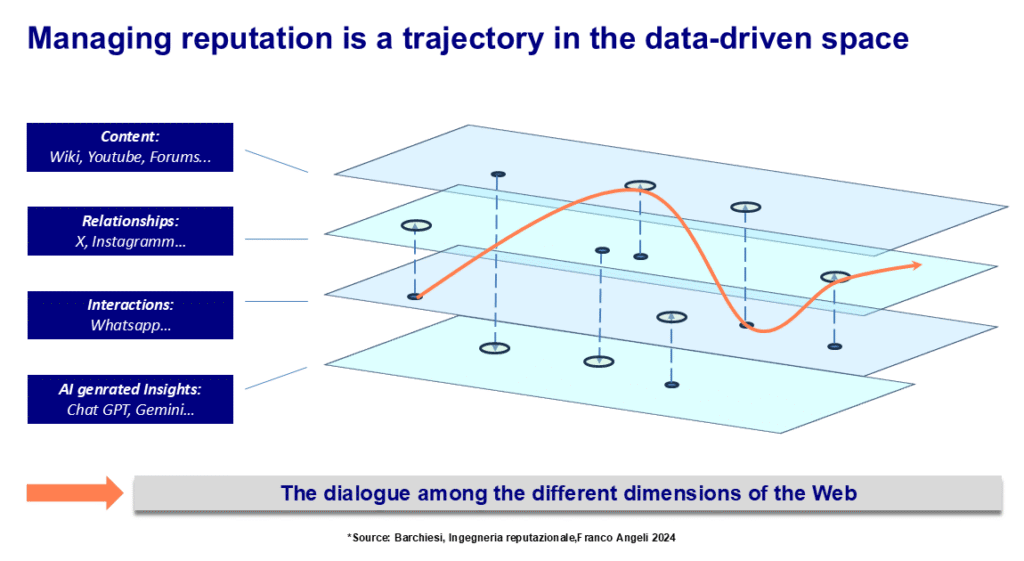
    To better explain it, managing reputation is a trajectory in a data-driven space: this requires senior leadership, via a Corporate Reputational Council (CRC), to model behavior and mitigate risks like information overload during crises, when excessive or unclear communication can mislead stakeholders (Barchiesi, 2024) or old events can be recalled even without any connection to the present situations.

    Boeing’s 737 MAX crisis and governance lapses have cost $20 billion, demonstrating that branding can’t mask poor behavior. Starbucks’ 2018 pivot exemplifies swift, authentic action.

    Leaders who embody values amplify credibility; those who contradict them erode it instantly.

    Building Digital Reputation Resilience

    Resilience is a nervous system characterized by constant, anticipatory, and systemic properties. It includes:

    Anticipate threats; social, operational, reputational. Tencent missed privacy sentiment.

    Route crises to decision-makers fast. United’s delay in 2017 amplified the fallout.

    Ditch PR varnish. Stakeholders demand transparency, not spin.

    Link reputation to enterprise risk and capital. Bain pegs reputational value at $1–$5 billion.

    For example, AI could have cut United Airlines’ 2017 response time from days to hours, potentially saving 2% of its stock drop.

    Stakeholder dynamics will fragment further. AI will feed personalized X streams (former Twitter), target employees with whistleblower prompts, and simulate ESG scenarios for investors.

    According to the team at MIT Sloan, the Orchestration pillar will leverage AI as a copilot to synchronize micro-narratives across channels, enabling organizations to embed AI in workflows and realize double-digit value creation.

    Resilience will shift to predictive AI, forecasting crises with 95% accuracy and shrinking response windows to minutes. ESG-linked “reputation bonds” could dynamically adjust capital costs.

    Regulators will wield AI audits, as Meta’s 2023 GDPR fine foreshadows, penalizing opaque AI use. In this context, a new pillar, AI Governance, may emerge to ensure ethical AI maintains trust.

    The future isn’t just digital. It’s algorithmic.

    Reputation Is the Operating System of Trust

    Branding is the skin; reputation is the nervous system. It governs stakeholder trust, risk tolerance, and viability. Confuse them, and you’re firefighting with gasoline.

    The 5+2 Pillar Framework, comprising transparency, alignment, agility, orchestration, and resilience, provides a strategic compass backed by data and global evidence, and evolves in response to the advancement of AI. It’s not about surviving scrutiny; it’s about thriving under it.

    Reputation must be governed at the highest levels, embedded in strategy, and continually shaped through daily behavior. Digital technology, and soon AI, make it vulnerable but measurable, responsive, and recoverable. A company’s future hinges not on what it sells, but on what it stands for, how it acts, and how it’s experienced. Reputation isn’t what you say, it’s what others say when you’re not in the room. In the digital age, that room is always open.

    AI tools like Talkwalker can now predict crises with 80% accuracy. ESG-linked financing is becoming a reputational accelerant. The organizations that build this muscle will own the future.

    The Horizon – AI and the Future of Reputation

    By 2030, artificial intelligence will redefine the reputation battlefield, amplifying risks and opportunities.

    For instance, AI-driven bots and deepfakes could fabricate crises: a viral “CEO scandal” video, generated in minutes, can spread faster than fact-checking can keep pace. The use of Tools like Talkwalker, with 80% predictive accuracy in 2025 pilots, becomes crucial: these tools will evolve into “truth engines” using natural language processing to flag misinformation. Ignoring emerging digital-trust risks can erode stakeholder confidence at breakneck speed; over 80% of consumers lose trust after a breach, and 25% walk away entirely.

    On the other side, AI represents a strong opportunity for reputational engineering techniques, since it can proactively help to scan the four dimensions of the web:

    • Content (e.g., YouTube, Wikipedia, Forums),
    • Interactions (e.g., WhatsApp),
    • Relationships (e.g., X, Instagram),
    • AI-generated insights (e.g., ChatGPT) – using SDI techniques, including predictive analysis, social media monitoring, and emotional impact assessment.

    It enables taking control of the entire volume of data (current and historical information), allowing for real-time sentiment tracking and crisis prevention, thus minimizing business impact by accelerating response times to deliver accurate information to stakeholders.

    About Gryphon Citadel

    Gryphon Citadel is a management consulting firm headquartered in Philadelphia, PA, with a European office in Zurich, Switzerland. Recognized for our strategic insight, our team provides invaluable advice to clients across diverse industries. Our mission is to empower businesses to adapt and flourish by infusing innovation into every aspect of their operations, resulting in tangible, measurable outcomes. Our comprehensive service portfolio encompasses strategic planning and execution, digital and organizational transformations, performance enhancement, supply chain and manufacturing optimization, workforce development, operational planning and control, advanced information technology solutions, and increasingly, managing corporate reputation as both a strategic asset and a business imperative.

    At Gryphon Citadel, we understand that every client has unique needs. We tailor our approach and services to help them unlock their full potential and achieve their business objectives in the rapidly evolving market. In a world where perception and trust can shape long-term viability, we help organizations build, protect, and enhance their reputations—aligning brand, behavior, and stakeholder expectations.

    We are committed to making a positive impact not only on our clients but also on our people and the broader community. At Gryphon Citadel, we transcend mere adaptation; we empower our clients to architect their future. Success isn’t about keeping pace; it’s about reshaping the game itself. The question isn’t whether you’ll be part of what’s next – it’s whether you’ll define it.

    Our team collaborates closely with clients to develop and execute strategies that yield tangible results, helping them to thrive amid complex business challenges while maintaining the reputational resilience that sustains stakeholder confidence. Let’s set the new standard together. If you’re looking for a consulting partner to guide you through your business hurdles and drive success, Gryphon Citadel is here to support you.

    Explore what we can achieve together at www.gryphoncitadel.com

    Share
