

|
Voice of the Citadel
Getting your Trinity Audio player ready...
|
Organizations don’t suffer from a lack of information. They suffer from a lack of truth. And truth, more often than not, arrives wearing resistance.
In the pursuit of clarity, most leadership teams aren’t struggling with tools or frameworks. They’re struggling with friction. Not because there’s too much of it, but because there’s not nearly enough.
The Problem – False Alignment in High-Velocity Environments
Modern organizations have become remarkably proficient at projecting unity. Plans are polished. Stakeholders aligned. Dashboards glow with false certainty.
But beneath the surface, decisions begin to unravel. Execution drifts. Strategy fragments. What appears to be alignment is often just the quiet buildup of unspoken disagreement, coherence in appearance, not in action.
This isn’t about malice or incompetence. It’s structural. The rhythm of business has shifted, from human pace to machine speed. In that rush, leadership compresses planning, abbreviates decisions, and substitutes consensus for challenge. Alignment gets confused with acquiescence.
Most organizations don’t have an information problem.
They have an honesty problem.
Friction, the productive kind that precedes clarity, is treated as inefficiency. But insight demands resistance. As Patrick Lencioni notes, ideological conflict is essential to high-functioning teams, and trust is its prerequisite. Without trust, there’s no friction, only performance.
As one executive put it plainly: “If no one’s pushing back, it means the real conversation already happened somewhere else.”
The Underlying Pain – Execution Without Integrity
When organizations prioritize the illusion of clarity over its actual achievement, dysfunction becomes systemic. Strategic initiatives falter. Budgets are overrun and rationalized. Teams dodge accountability because they never truly committed to the task. AI insights circulate without challenge because there was never a shared understanding of what mattered in the first place.
The result is a costly form of stasis disguised as speed. Execution continues, but without clarity. Everyone is moving, but not in the same direction or for the same reason.
A deeper breakdown emerges when companies design systems to eliminate friction, such as automated workflows, seamless dashboards, and precision stand-ups, without confronting the unresolved decisions, competing priorities, or strategic trade-offs that those systems were intended to support.
In doing so, they mistake orchestration for understanding and confuse movement with momentum.
Use Case – Misaligned Digital Transformation
A global manufacturer deployed an AI-driven production planning system to streamline operations. However, the core trade-offs between supply chain volatility, engineering constraints, and customer commitments were never clearly defined.
Cross-functional tension was suppressed in the name of speed, allowing the platform to automate flawed assumptions at scale. Production was optimized, but in the wrong direction.
By engineering out disagreement, the company confused orchestration for understanding. Clarity was never contested. So it was never real.
Why Friction Is Not Dysfunction, But Discipline
We’ve seen the pattern repeat across industries and models: the moment real friction surfaces, the real work begins.
Friction isn’t the obstacle to clarity. It’s the indicator that clarity is within reach.
Tension between product and sales, operations and finance, risk and innovation doesn’t signal dysfunction. It signals engagement. What matters is not disagreement itself, but whether it’s surfaced early and resolved deliberately.
In this frame, clarity is not a noun; it’s a verb. It’s something you earn through dialogue, discipline, and trust. It requires a leadership culture that leans into tension, not away from it.
Strategy, by its nature, is contested terrain.
If it isn’t, you’re either not aiming high enough, or no one’s telling the truth.
The Turning Point – Stop Treating Friction as Waste
The fundamental mistake leadership teams make is believing that friction slows progress. But it’s the absence of friction that derails outcomes – just not right away.
Speed without scrutiny leads to strategic drift. Technology deployed without debate automates assumptions rather than solving problems. Decisions made in echo chambers often land in environments unprepared to absorb them.
In an era of agentic AI, digital platforms, and cross-functional delivery, the risk only compounds. These systems don’t correct for human avoidance. They institutionalize it. Frictionless inputs become risk accelerants at machine speed.
In this new environment, friction isn’t inefficiency; it’s a natural consequence. It’s governance.
The Leadership Gap – Mistaking Efficiency for Effectiveness
Today’s leaders operate under a double bind: move faster, but still get it right. What gets lost is the depth of engagement required to do both. Meetings shrink. Decisions turn performative. Conversations get filtered.
What emerges is not clarity, but its performance. Strategic issues are declared resolved before they’re even defined. Assumptions go untested. Disagreement gets mistaken for disloyalty.
What’s needed isn’t more dashboards or better data. It’s better dialogue.
High-functioning leadership teams create space for friction. They ask harder questions. They linger in discomfort long enough to surface root issues, not just visible symptoms. They understand that clarity is earned through conflict, not declared by consensus.
When incorporated into leadership dialogue, friction becomes a diagnostic tool, revealing where alignment is performative and where commitment is genuine. It doesn’t distract from execution. It’s what makes execution grounded.
Leaders who equate speed with effectiveness miss the point. They rush through symptoms instead of solving systems. The real work begins when they stay with the tension long enough to name the problem and take ownership of the fix.
Use Case – Performance Theater in Leadership Reviews
A fast-growing SaaS company rolled out biweekly OKR reviews to sharpen leadership focus. At first glance, the process seemed to drive accountability. But behind the scenes, the meetings became performance theater, carefully scripted, tightly choreographed, and conflict-free.
No one confronted the contradictions – conflicting goals, flawed metrics, and misaligned incentives. Metrics initially appeared to be good, but customer churn revealed the actual cost.
Without a structured space for productive tension, the process became an echo chamber of compliance. The system continued to report success while silently drifting off course.
Building the Infrastructure for Productive Friction
Clarity isn’t a moment. It’s the product of a system built to challenge itself. High-performing organizations invest in routines that surface and metabolize friction constructively, consistently, and without delay.
They bake cross-functional tension into operating cadences, not through endless alignment meetings, but through tension-balanced decision councils that expose trade-offs rather than soften them. They conduct structured pre-mortems to stress-test where goals collide, assumptions diverge, or incentives compete.
They normalize dissent as discipline, not disloyalty, training senior leaders to listen deeply, disagree directly, and converge responsibly. And they treat clarity not as a one-time deliverable, but as a dynamic state, refined through governance rituals that challenge stasis.
What emerges isn’t confusion, but operational clarity. Not conflict, but convergence.
And where does this breakdown most often? Middle managers usually filter out tension in the name of harmony. But harmony without challenge is the enemy of coherence.
The Enterprise Cost of Avoiding the Rub
Shallow alignment isn’t just a cultural liability; it’s a financial one. Margins erode when execution drifts. Growth stalls when go-to-market assumptions go unchallenged. And top talent disengages when no one is willing to say, “This isn’t working.”
The longer an organization suppresses friction, the more expensive it becomes to make course corrections. As AI and automation compress delivery timelines, the margin for recovery shrinks with each passing quarter. Soon, there’s nowhere left to hide.
What We Have Learned
We don’t pursue friction for its own sake. We seek it because its absence is almost always a warning sign of suppressed trust, faltering confidence, and the illusion of clarity.
In our most transformative engagements, the breakthrough never came from a better model, a tighter framework, or the latest platform investment. It came when one voice broke the surface, ‘I disagree.’
That moment created space for truth because trust was strong enough to hold it.
At Gryphon Citadel, we build systems, cultures, and leadership norms that invite friction with intention and resolve it with discipline. Not to slow teams down, but to unlock real speed: strategic speed, governed by clarity, not theater.
Use Case – “I Disagree” as a Catalyst
In an engagement with a financial services firm, a digital onboarding initiative had stalled for nine months, stuck in a cycle of polished metrics, scripted meetings, and a lack of clear ownership. The breakthrough didn’t come from another strategy deck. It came when one leader finally said, “I disagree with the entire premise.”
That single act of dissent exposed the underlying issue. Core assumptions were revisited. Hidden tensions surfaced. The team reframed the initiative to focus on the actual needs of customers.
Within three weeks, ambiguity gave way to alignment. In 90 days, onboarding time decreased by 28%, NPS increased by 11 points, and rework was reduced by half. Friction wasn’t the obstacle; it was the catalyst.
Yet this kind of breakthrough is rare. Why? Because middle managers often suppress tension in pursuit of harmony. But harmony that goes untested breeds misalignment and eventually, entropy.
Diagnostic Tool – Where Is Friction Being Filtered?
To make friction actionable, leaders must ask: Where are we pretending to align? This self-assessment exposes hidden drift across four critical dimensions:
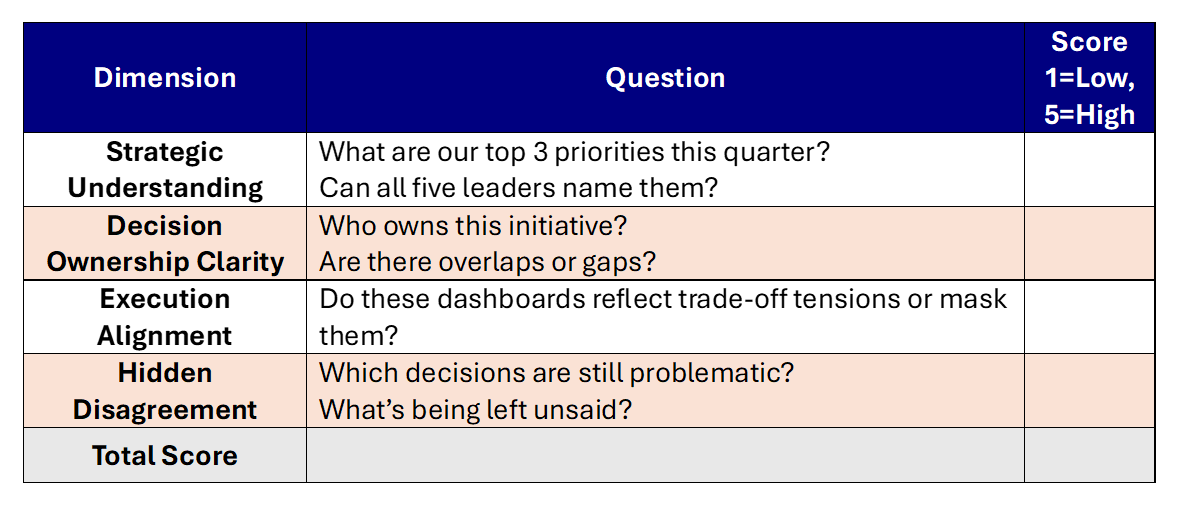
How to use it: Any score below 4 (on a 1–5 scale) triggers a “Friction Conversation” in the next leadership meeting.
Use this framework not as a scorecard, but as a friction radar designed to reveal where clarity is being avoided and where tension needs to be invited.
The following table helps leaders assess their organizational friction maturity. What level reflects your leadership culture?
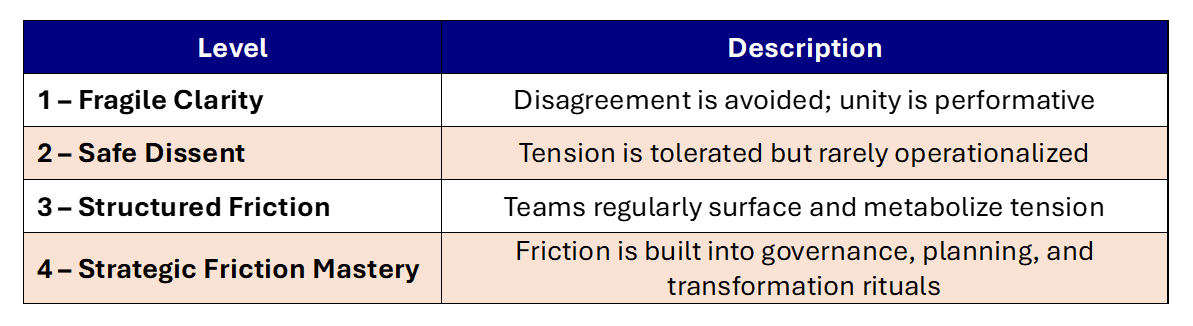
When unity looks polished but clarity runs shallow, you get frictionless failure.
The cure? Structured tension. Surfaced through disciplined questions. Anchored in data and routed through decision-making forums.
This is what leadership clarity looks like in action.
If It’s Too Smooth, It Probably Isn’t Real
The organizations that will win in the next era won’t be the ones that avoid friction. They’ll be the ones who understood it and built it into how they lead.
Because clarity without friction is almost always camouflage.
So pause and ask yourself:
- Where has alignment in your organization come too easily?
- Where have disagreements gone silent?
- Where has clarity been declared, but never demonstrated?
These aren’t warning signs. They’re invitations.
Invitations to return to the real work of leadership, not just setting direction, but forging shared understanding through tension.
Clarity is not declared. It’s earned by those willing to stay in the discomfort long enough to find the truth.
If the room’s too smooth, the truth may have already left it.
Gryphon Citadel. Where clarity gets built, not inherited.
About Gryphon Citadel
Gryphon Citadel is a management consulting firm headquartered in Philadelphia, PA, with a European office in Zurich, Switzerland. Known for our strategic insight, our team delivers invaluable advice to clients across various industries. Our mission is to empower businesses to adapt and flourish by infusing innovation into every aspect of their operations, leading to tangible, measurable results. Our comprehensive service portfolio includes strategic planning and execution, digital and organizational transformations, performance enhancement, supply chain and manufacturing optimization, workforce development, operational planning and control, and advanced information technology solutions.
At Gryphon Citadel, we understand that every client has unique needs. We tailor our approach and services to help them unlock their full potential and achieve their business objectives in the rapidly evolving market. We are committed to making a positive impact not only on our clients but also on our people and the broader community. At Gryphon Citadel, we transcend mere adaptation; we empower our clients to architect their future. Success isn’t about keeping pace; it’s about reshaping the game itself. The question isn’t whether you’ll be part of what’s next—it’s whether you’ll define it.
Our team collaborates closely with clients to develop and execute strategies that yield tangible results, helping them to thrive amid complex business challenges. Let’s set the new standard together. If you’re looking for a consulting partner to guide you through your business hurdles and drive success, Gryphon Citadel is here to support you.
Explore what we can achieve together at www.gryphoncitadel.com
