

|
Voice of the Citadel
Getting your Trinity Audio player ready...
|
Abstract
Strategic Reflex Architecture™ outlines a governed, closed-loop approach to keeping strategic intent aligned with execution as conditions change. It addresses strategic drift, the widening gap between leadership priorities and operational decisions, by linking agentic orchestration with causal reasoning. Agents coordinate authorized work across functions; causal models make assumptions explicit and help leaders compare the likely consequences of alternative actions. Decision rights, human oversight, and outcome measurement connect these capabilities to enterprise accountability. Illustrative life sciences and energy scenarios show how the loop could operate and distinguish potential benefits from measured deployment results. The leadership task is to codify intent, test assumptions, deploy within defined authority, and use observed outcomes to improve the next decision. Assess performance using decision quality, execution time, and realized business value.
Strategic Reflex Architecture™ is a governed operating architecture that connects strategic intent, causal reasoning, agentic execution, and outcome measurement in a continuous decision loop.
Introduction
Compressing planning cycles or adding more dashboards is not enough. What is needed is Strategic Reflex™: an enterprise architecture through which leaders continually sense change, evaluate responses, coordinate action, and review results. Execution becomes a source of evidence about the strategy itself. The architecture connects existing data, analytical tools, workflows, and accountable teams around a common decision process, making adaptation an operating discipline.
Two capabilities make this possible. Agentic AI provides an orchestration layer that lets specialized agents gather information, propose actions, and execute authorized tasks across functions and geographies. Causal reasoning provides the analytical
discipline to examine why outcomes change and what an intervention might produce. Their integration requires reliable data, access to operational systems, and clear ownership of the decisions being delegated.
Together, these capabilities create a structure for linking strategic choices to operational feedback. Leaders can act on changing conditions while retaining visibility into the evidence, assumptions, approvals, and outcomes behind each move. The quality of that loop depends on how it is designed and governed. Advantage comes from decisions that stay relevant and improve business performance, measured over time.
What We Mean by Agentic AI
Software agents that pursue defined enterprise goals by interpreting information, selecting steps, and using tools, with autonomy limited by permissions, decision rights, and human oversight.
What We Mean by Causal Reasoning
Methods for estimating cause-and-effect relationships, using explicit assumptions, domain knowledge, and evidence to assess interventions and examine alternative outcomes.
Source: Microsoft Research DoWhy causal inference framework 2020
The Core Problem – Strategic Drift is the Silent Killer
The consequences of weak assumptions are visible in capital investment. A 2024 study by Hoque and colleagues, covering 164 large-scale transit infrastructure projects in the United States, found that actual ridership averaged 24.6% below forecasts and that about 70% of projects overpredicted demand. The study also found that forecast accuracy had improved over time, particularly after 2000. These findings concern forecast risk in U.S. transit investment. For enterprise leaders, they show the importance of revisiting assumptions as conditions change, especially when capital commitments are hard to reverse.
Recent AI research makes the execution gap visible in a new form. In McKinsey’s August 2026 global survey, 80% of respondents reported improvements in individual productivity, while 37% attributed at least some enterprise EBIT impact to AI. Bain’s October 2026 research, covering 951 companies and 63 enterprise processes, reported that roughly 38% of expected AI value had become deployed, measurable value. These are different measures from different studies, but both distinguish technology use from enterprise results. For Strategic Reflex Architecture™, the implication is to measure whether better decisions improve completed transactions, service levels, margin, and cash, rather than treating agent deployment or activity as value in itself.
The danger lies in drift’s disguise. Dashboards remain green. KPIs show progress. Milestones are delivered on time. Yet all the while, the enterprise is moving with greater precision in the wrong direction, perfecting an obsolete plan. Strategic drift is not inefficiency; it is a systemic, compounding threat that undermines competitiveness until recovery demands wholesale reinvention.
Agentic AI – Your Strategic Nervous System
Once strategic drift takes hold, a dashboard refresh or leadership off-site may identify the problem without changing how the enterprise responds. A structural capability is needed to connect relevant signals with decisions and coordinated action. Agentic AI can provide part of that capability: an enterprise orchestration layer that helps teams respond while conditions are still actionable.
Like a strategic nervous system, this layer connects signals from across the enterprise with the teams and systems able to act on them. Specialized agents can assemble information, compare options, initiate authorized workflows, and escalate exceptions across functional and geographic boundaries. Shared objectives and clear decision rights are essential, particularly when local priorities conflict with enterprise goals. Coordination must be designed into the operating model.
This capability extends beyond automating isolated tasks. A regional demand change could trigger a review of inventory and production options. A competitor’s price cut could prompt an assessment of margin and customer response. A port disruption could initiate comparisons of alternative routes and suppliers. The speed and value of the response depend on data quality, system integration, available capacity, and the permissions attached to each action.
Agentic AI can reduce the time spent gathering information and coordinating handoffs. Capturing results also creates an opportunity for learning, but feedback alone does not demonstrate improvement. Changes to causal models, prompts, tools, or agent policies should be evaluated, versioned, and approved before wider deployment. Performance reviews must establish whether those changes improve decision quality and business outcomes under the conditions in which the system will operate.
Autonomy is a design choice with explicit limits. NIST’s 2026 AI Agent Standards Initiative highlights the importance of security, identity, and interoperability as agents interact with enterprise systems. In Strategic Reflex Architecture™, that translates into defined owners, access limited to the task, transaction limits, decision logs, escalation routes, and mechanisms to pause actions or recover from errors. Leaders determine which decisions can be delegated and which require human approval.
Causal Reasoning – The Enterprise’s Decision Physics
If Agentic AI is the enterprise’s strategic nervous system, causal reasoning is its decision physics. It asks how outcomes would change if leaders intervened, moving beyond the patterns used for prediction. Its value depends on making assumptions visible and testing them against relevant evidence. A plausible explanation or a causal graph does not establish cause and effect on its own.
In practice, causal models combine domain expertise, data, and assumptions about how variables influence one another. Leaders must distinguish the proposed relationships, whether the available evidence can identify an effect, and how that effect is estimated. Experiments, suitable natural experiments, and sensitivity analysis can strengthen the case for action. Models should also state where unmeasured influences or changing conditions could alter the conclusion. DoWhy’s research framework formalizes this sequence of modeling, identification, estimation, and refutation.
In causal analysis, a counterfactual asks what might have happened in an observed situation if a particular decision or condition had been different. The model changes that factor and allows its downstream effects to follow the assumed causal relationships, while preserving the relevant background circumstances. The answer is an estimate conditional on the model and its assumptions. For decisions about what to do next, intervention analysis examines the expected effects of alternative actions. PyWhy’s causal-inference documentation explains this distinction.
What We Mean by Counterfactuals
In causal analysis, a counterfactual test asks “what would have happened if…” by changing one factor in a model while keeping others constant. It determines the true impact of a single decision or event, helping leaders see which actions matter most before they allocate resources.
Within Strategic Reflex Architecture™, causal reasoning should make the basis for an intervention explicit: why it was selected, which alternatives were considered, and what outcome was expected. A decision record allows the leadership team to compare observed results with model estimates and investigate material differences. Evidence may support the existing model, expose a missing mechanism, or show that conditions have changed. The architecture should make those differences visible and assign responsibility for resolving them.
The practical value emerges when this analysis is connected to execution. Agentic AI can coordinate the work needed to implement a decision, while causal reasoning helps assess whether the proposed intervention is supported by evidence. The operating loop must also preserve the ability to challenge, pause, or revise a decision. It aims to improve decision quality and response time together, with performance measured against operational outcomes.
Platforms such as Parabole illustrate this direction. The company describes TRAIN as a causal inference platform that combines process data with engineering knowledge to explain deviations and evaluate possible changes. It states that supported platform-generated decisions record the model version, inputs, causal path, and binding constraints, while existing control systems retain setpoint authority. This distinction matters: decision support, workflow orchestration, and direct process control carry different responsibilities. As Rajib Saha, CEO of Parabole, notes:
“While siloed analytics keep enterprises busy explaining yesterday, Reflex architecture wonderfully unites expert knowledge with data through causal reasoning and agentic execution to deliver precise, transparent decisions at the time when needed most.”
— Rajib Saha, CEO, Parabole
Causal reasoning helps guard against mistaking activity for progress by requiring a clearer account of why an action is expected to work. Explainability and auditability also depend on accessible evidence, documented assumptions, versioned models, and recorded approvals. Together, those practices make decisions easier to inspect and improve. Strategic coherence remains a management responsibility, supported by the architecture and tested by results.
Strategic Reflex Architecture™ – Where Strategy Becomes Motion
Even a well-conceived strategy can lose value when the organization cannot revise decisions as conditions change. The design challenge is to connect strategic intent with timely, coordinated action, while preserving the evidence and accountability needed to judge whether that action improves outcomes.
As Michael Carroll, AI Scientist and Board Advisor, observes:
“Competitive advantage now lives in decision velocity. Strategic Reflex Architecture™ closes the gap between intent and action, creating an enterprise where strategy is a living system, continuously sensing change, reasoning through it, and moving at the speed it arrives. It shapes ideal outcomes both in the arenas leadership can influence through decisive action and in those it must navigate beyond its control.”
— Michael Carroll, AI Scientist and Board Advisor
Enterprises lose advantage when operating decisions continue to reflect assumptions that leadership has already outgrown. Strategic Reflex Architecture™ addresses that gap by linking priorities and constraints to the workflows through which the enterprise allocates resources, serves customers, and responds to disruption. Its role is to make the connection between intent and action explicit, reviewable, and responsive to new evidence.
The architecture connects two capabilities in a governed loop. Causal reasoning supports the assessment of interventions and their likely consequences. Agentic AI coordinates tasks and executes within delegated authority. Enterprise systems supply the data and transaction interfaces, while accountable leaders set objectives, resolve trade-offs, and approve material changes. A decision record connects the signal, the model, the action, and the result.
The loop should operate at a cadence suited to the decision. Pricing or inventory exceptions may permit rapid adjustment; capital commitments and regulated changes may require longer evaluation and formal approval. The operating sequence remains consistent:
- Detect relevant changes in market, customer, supplier, and operating data, with checks on freshness and reliability.
- Evaluate plausible causes and alternative interventions, documenting assumptions, uncertainty, constraints, and expected outcomes.
- Execute or escalate the chosen response according to decision rights, transaction limits, and approval requirements.
- Compare observed outcomes with expectations, investigate deviations, and test revisions before updating models or execution policies.
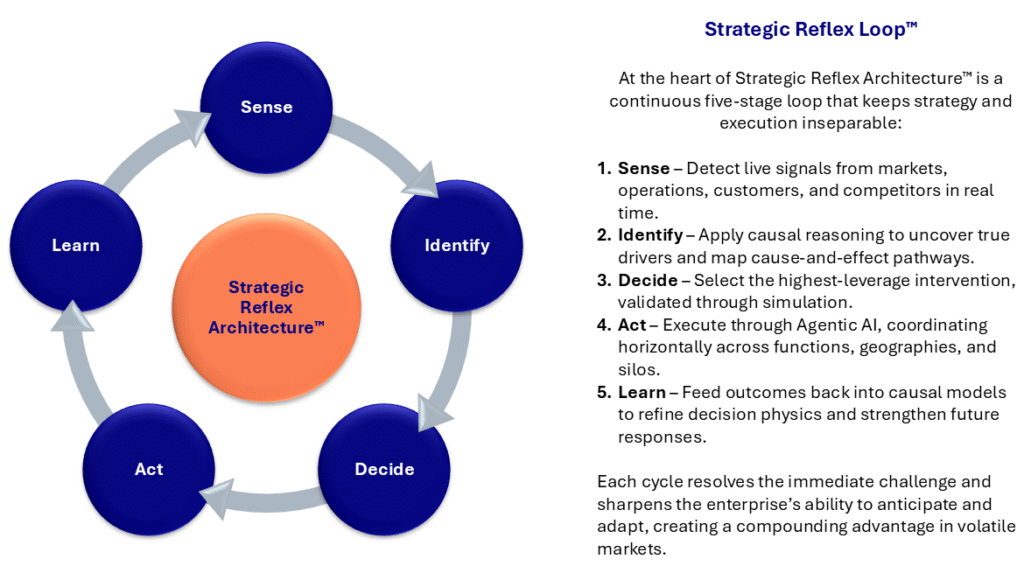
The result is an operating model for disciplined adaptation. Digital twins, forecasting tools, optimization engines, dashboards, and agile delivery practices can contribute to the loop by improving decisions or their execution. The distinguishing proposition of Strategic Reflex Architecture™ is the governed connection between strategic intent, evidence, coordinated action, and measured results across organizational boundaries.
Illustrative Composite Scenarios
The following scenarios are illustrative composites showing how Strategic Reflex Architecture™ could operate. They combine common operating challenges with hypothetical responses. They explain the decision sequence, responsibilities, and measures; financial and timing benefits would need to be established in a documented model or deployment.
A global pharmaceutical manufacturer is preparing to launch an oncology therapy when a key excipient supplier experiences a contamination shutdown. Agents assemble supplier, inventory, production, and launch information, while a causal model helps the team compare alternative sourcing and sequencing decisions under explicit assumptions. Quality and regulatory specialists assess supplier qualification, testing, change-control, and filing implications before changes proceed. Authorized agents can coordinate approved procurement and documentation tasks in parallel. The potential benefit is faster assessment and coordination, with testing, manufacturing, and external review timelines reflected in the decision.
A Gulf Coast refinery loses access to a major crude source when a shipping route closes. Agents gather information on alternative grades, transport capacity, inventories, and commitments. Causal analysis, combined with process and optimization models, helps engineers compare the likely effects of alternative feedstock and blending choices on throughput, product quality, and margin. Process engineers and operators retain authority over operating limits and control-system changes.
Once a response is approved, agents can coordinate purchasing, logistics, and scheduling within delegated limits. The outcome is assessed against the actual operating and financial results.
Evaluation should compare a defined baseline or suitable comparison group with observed results, document major changes in operating conditions, and distinguish modeled benefit from realized benefit. Useful measures include signal-to-decision time, decision-to-approved-action time, and time to the operational result. Faster decisions should improve throughput, on-time service, quality, working capital, or incremental margin after accounting for integration, operating, supervision, and rework costs. Evidence of acceleration alone is insufficient to establish financial impact.
Different industries. The same reflex: sense, evaluate, decide, act, and learn. The purpose is to reduce avoidable delays while improving decision relevance and quality. Strategic Reflex Architecture™ is designed to help leaders detect drift earlier, adapt execution, and achieve better business outcomes.
Leadership Imperative – Codify. Simulate. Deploy.
In a market where conditions can pivot overnight, strategic intent must be translated into operating choices that can be reviewed and revised as evidence changes. The leadership mandate is to establish the priorities, decision rights, and measures that allow adaptation to improve performance. Strategic Reflex Architecture™ provides a framework for making that mandate operational.
Codify. Translate strategic intent into explicit, machine-readable objectives, constraints, and decision rules. Define how the enterprise resolves trade-offs among growth, margin, cash, service, quality, and risk. Assign an accountable owner to each material decision, and specify what agents may recommend, execute, and when they must escalate. Leaders must also define how priorities and permissions are revised when the strategy changes.
Simulate. Examine the consequences of alternative interventions using the strongest evidence available. State the assumptions, uncertainty, and operating conditions under which the model is expected to hold. Use experiments or suitable comparisons where feasible, and sensitivity analysis where evidence is incomplete. Counterfactual analysis can also help examine past decisions. Simulation should expose where a decision is robust and where additional evidence or human judgment is needed.
Deploy. Connect approved decisions to coordinated workflows and delegated authority. Begin with actions whose results can be observed and whose operating risks are understood. Record the model version, evidence, approvals, actions, and outcomes. Review exceptions and material deviations, then test changes before expanding autonomy. The objective is sustained improvement in enterprise performance, supported by evidence from actual operation.
For CEOs, the starting point is immediate and concrete:
- Select a consequential domain where drift is costly and where data, decision ownership, and outcomes can be observed. Establish the current decision cycle and a baseline for business performance.
- Map the decisions, causal assumptions, dependencies, constraints, and approval rights in that domain. Define the evidence needed to support each intervention.
- Introduce agents in a bounded workflow, starting with recommendations or supervised execution where appropriate. Test reliability, integration, exceptions, and operating economics before expanding authority.
- Compare actual results with the baseline and expected outcomes. Investigate deviations, test revisions, and scale when the evidence supports a broader deployment.
The organizations that build this discipline can make strategy more responsive to the conditions in which it must perform. Their advantage will depend on the quality of their evidence, the clarity of their decision rights, and their ability to turn approved choices into measurable results. Strategic Reflex Architecture™ connects those responsibilities in a continuous operating loop.
Final Word – Don’t update your strategy. Operationalize it.
Gryphon Citadel thanks Rajib Saha, CEO of Parabole, and Michael Carroll, AI Scientist and Board Advisor, for their insights and contributions to this perspective on Strategic Reflex Architecture™.
Publication history
Gryphon Citadel published this article by Mark Hassenplug on August 14, 2025. It introduced Strategic Reflex Architecture™ and described how causal reasoning and agentic AI could help leaders detect and respond to strategic drift. Gryphon Citadel subsequently expanded on the architecture in its Viewpoint, Strategic Reflex Architecture™ – Perpetual Strategic Advantage. On October 22, 2026, the firm formally announced the launch of Strategic Reflex Architecture™ through Newsfile.
About Gryphon Citadel
Gryphon Citadel is a management consulting firm headquartered in the Philadelphia area, with a European office in Zurich, Switzerland. We help leaders make consequential choices and build the capabilities to carry them through. Our work spans strategic planning and execution, digital and organizational transformation, AI and advanced technology, performance improvement, supply chain and manufacturing optimization, workforce development, and operational planning and control.
We bring these disciplines together to address complex business challenges from diagnosis through implementation. By aligning leadership priorities, operating capabilities, and measures of success, we help clients adapt to changing conditions and achieve results they can see in their organizations’ performance.
Learn more at gryphoncitadel.com.
